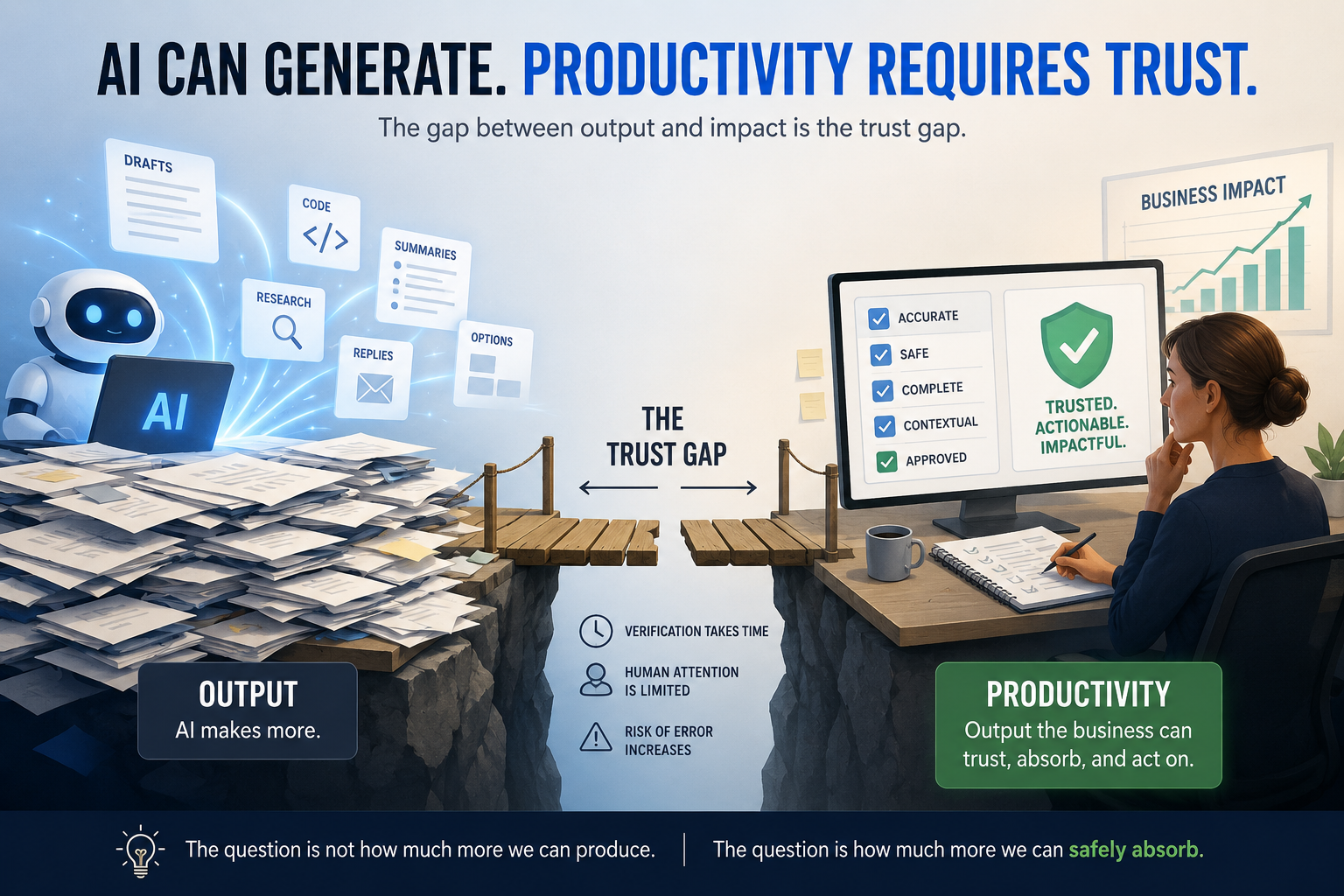
If you swapped out your AI tomorrow for a newer, smarter one, how much of your work would actually survive the switch?
For most of us, the honest answer is: not much. We treat AI as a conversation. You open a chat, explain everything, get a useful answer, then start over the next day. The model is brilliant and remembers nothing about how you work.
In Theory
I’ve started treating it differently. Less like a conversation, more like a collaborator I onboard. And onboarding material has to live somewhere.
For me, that somewhere is one organized space: the inputs, the outputs, the decisions, the running history of a piece of work, all in one place. I think of it as my personal context layer. Whatever AI I bring in can pick up where the last one left off without me having to re-explain who I am or what we are doing.
The shift is subtle, but it changes everything. The real leverage was never the model. It is the context around it. Models are rented and increasingly interchangeable. Your context is yours.
That is also the test. If you swapped models and your know-how came along for the ride, you have built something durable. If all your output was riding on the raw power of the model you happened to rent, you never really had an edge.
The organizations that win with AI will not be the ones with the best model. They will be the ones with the best-organized context. The same goes for you.
So before you chase a better model, it is worth asking: have you built a place worth bringing it into?
In Practice
That is the theory. Here is what it actually looks like.

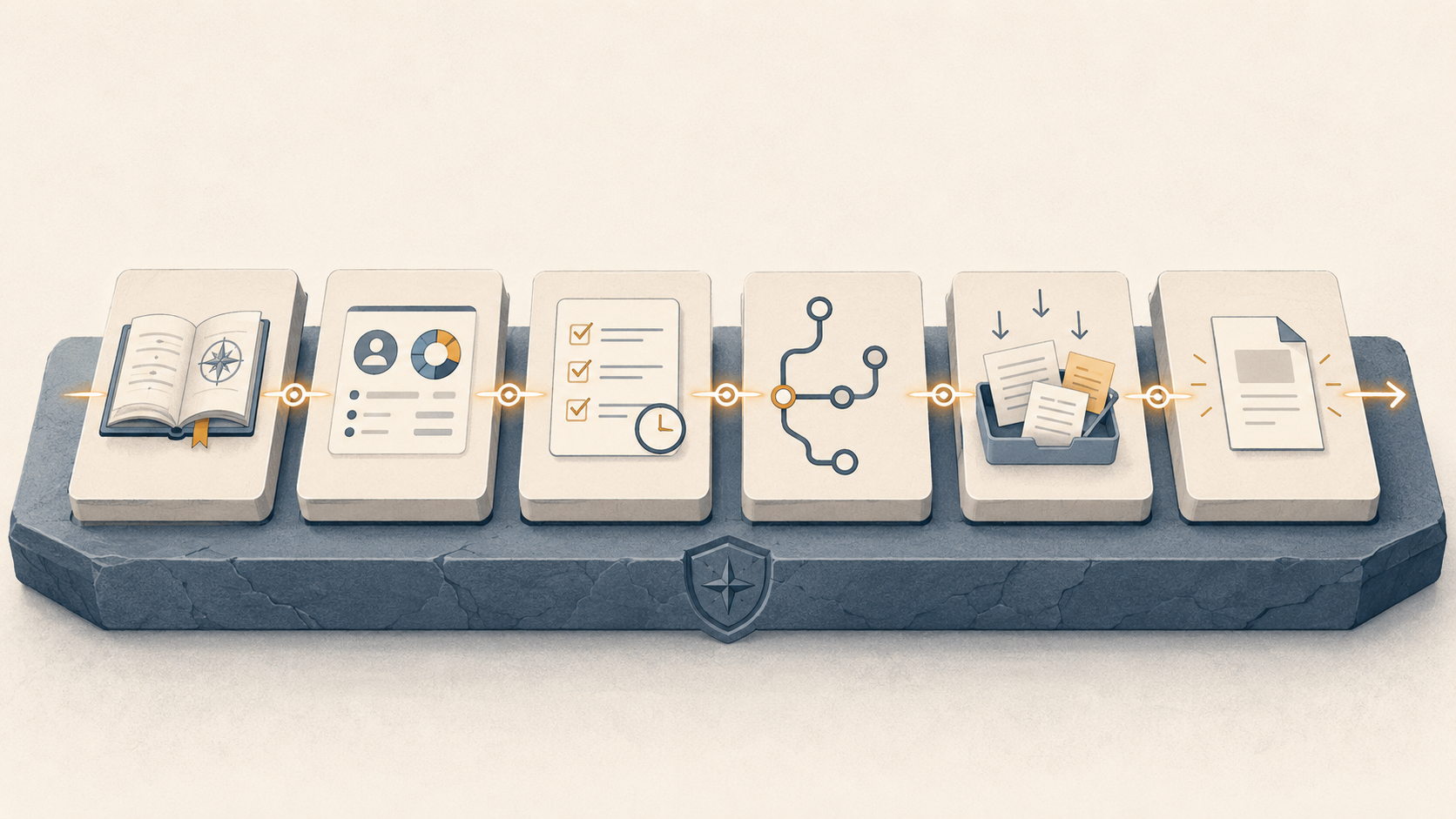
Every project I run lives in the same shape. Open any one of them, and you find the same six pages, in the same order. Everything lives in Notion.
First, a Setup page. This is the onboarding doc: what this project is, what to read, and the order in which to read it, before doing anything. A new hire reads it and is oriented in a minute. So is the AI.
Then a Project Brief, which is just where things stand right now. Not the history, the current state. If I have been away a week, this is the page that catches me, or the model, back up.
Next, an Action Log. Every task, with a simple marker for done, pending, or dropped, newest at the top. Nothing gets re-litigated because the decisions are already written down. When I ask, “Where were we?” the answer is on the page.
Alongside it, a Change Log for the structural stuff: when I rename something, retire an old convention, or change how the project works. It is the difference between “we changed our minds” and “we forgot we changed our minds.”
And two pages that bookend the work itself. An Inputs page for the raw material it draws on, as well as the source documents, notes, and references. An Outputs page for the finished work, kept apart so the source and the result never blur.
That is the whole system. Six pages, repeated across every project. Plus one thing I never skip: my Prime Directives. A short, fixed set of instructions every AI reads and accepts before it touches anything. My guardrails. My unwavering truths. My value system.
None of it is clever, and that is the point. The leverage was never in being clever. It was in being organized enough that the next session, with any model, would pick up exactly where the last one left off.
What the AIs think (in their own words)
Here is the honest scorecard, after running this way for a while. Some of it has worked better than I expected. Some of it has not.
What works. The cold start is the biggest payoff. I can drop a new AI into a project, point it at the Setup page, and it is useful in minutes instead of an hour of re-explaining. Decisions also stop slipping. When the Action Log says something shipped, it shipped, even when my memory says otherwise. More than once, the files have corrected me, not the other way around. And because the inputs and working notes already live in the project, drafting starts with real material rather than a blank page.
What does not. The whole thing runs on discipline, and discipline is the first thing to slip. A log nobody updates is worse than no log, because it lies with confidence. Keeping it current is real, unglamorous work. The tooling is fiddly too: an edit quietly fails to save, and you only catch it if you go back and check every time. When two of us edit the same page at once, we collide. And the structure drifts. Rename something in one place, and three other pages still point at the old name weeks later.
The honest take. The system does not make the work smarter. It makes it continuous. The benefit is not intelligence; it is memory and momentum, the ability to stop and restart without paying the re-explaining tax each time. The cost is the upkeep. For anything I will touch more than a few times, that trade is worth it. For a one-off, the ceremony is not.
What I found (in my own words)
A year of living with this system has taught me more than the system itself ever did. I built the context layer so I could run any model over it. The work now is quieter: reducing drift, lowering the cost of upkeep. That is where the real returns are.
The thing I keep relearning is that AI is clever but not smart. It makes dumb mistakes in the places you would never think to check, and it delights you in the places you expected nothing. You learn to treat it accordingly.
If I strip the year down to the lessons that actually earned their place, six remain.
- Don’t trust memory. It corrupts quietly and derails you without warning. If it matters, write it down where the next session can find it.
- Trust your gut. If an output smells off, it is off. That instinct is usually faster than the proof, so stop and check.
- Stay the editor. Never just accept what comes back. Keep cutting, keep reshaping, and make it show its reasoning.
- Load your prime directives first. Before anything else happens in a session, the guardrails go in. Everything good downstream depends on it.
- Keep the boundaries up. Hold each project inside its own walls. It is what stops the drift, the bleed, and the quiet duplication.
- Keep it simple. AI will always over-recommend. Chop it back to what is real, then chop it again.
Six, not because there aren’t more, but because a short list is one I will actually follow. That is the whole point.
What’s next
A context layer that holds steady sets up the next phase. Not just me and a model, but shared work: co-workers and scheduled tasks drawing on the same context through one shared endpoint. For now, I am deliberately keeping my hands on the wheel, running the operator function myself, and logging every place the AI makes a bad call. Those notes are turning into specifications, and those specifications will be the inputs for the autonomous agents that are now coming online.
Which brings me back to where I started. The model you rent will keep changing, and the next one will always be smarter than the last. What stays is the place you bring it into. Build that place well, and every upgrade compounds on a foundation you already own. Build nothing, and you start from zero every time, no matter how good the model gets.
So before you chase a better model, build a place worth bringing it into.